


Commercial Vehicle Branding Safety Compliance Guide
Table of Contents
- Why Commercial Vehicle Branding Safety Compliance Matters
- Fleet Vehicle Signage Compliance: What the Rules Require
- Choosing Commercial Vehicle Safety Decals That Last
- Reflective Decals for Trucks: Improving Night Visibility
- Vehicle Graphics Placement: Avoiding Safety Risks
- Compliance Review Workflow Before and After Installation
- Maintenance and Reinspection of Safety Markings
- Conclusion: Building a Compliant, Visible Fleet
- Frequently Asked Questions
Last Updated: October 8, 2026
Why Commercial Vehicle Branding Safety Compliance Matters
Commercial vehicle branding safety compliance means applying signage, decals and wraps to a work vehicle so it promotes the business while still meeting the visibility, identification and roadworthiness rules for that vehicle class. Get it right and your branding sells while keeping the vehicle legal; get it wrong and you risk defect notices, rejected insurance claims and avoidable incidents.
At Mega Sticker Store, we make Australian-made decals for caravans, motorhomes, 4WDs, boats and business vehicles.
Fleet Vehicle Signage Compliance: What the Rules Require
Fleet vehicle signage compliance starts with three questions: what class of vehicle is it, what does the relevant authority require of that class, and does your signage interfere with any of it.
The rules are set by state and territory road agencies and the national vehicle standards framework, and vary by vehicle class and operating environment.
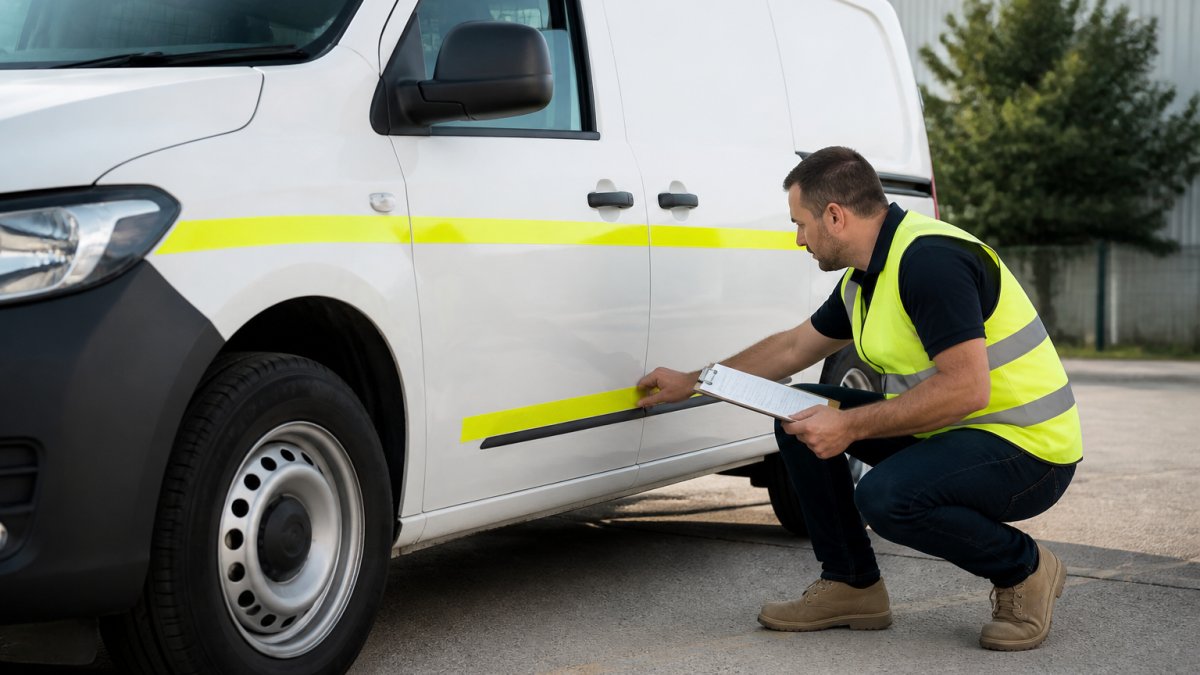
The Three Layers of Rules That Apply to Branded Vehicles
Most compliance failures happen because a business checks one layer and assumes it has covered the others. There are three, and they stack:
- National vehicle standards. The Australian Design Rules (ADRs) set the baseline every vehicle must meet to be roadworthy, covering lighting, reflectors, glazing, mirrors and fields of view. A wrap or decal that compromises any of these can render the vehicle non-compliant regardless of what a state authority permits.
- State and territory road rules and registration conditions. Each jurisdiction's transport authority administers registration, defect notices and heavy vehicle accreditation. It is the body that will inspect your vehicle and the body whose signage and identification requirements you must meet.
- Local and site-specific requirements. Council permits for advertising on parked vehicles, workplace health and safety rules on construction and mining sites, and operator-specific identification for certain contracts sit on top of the first two layers.
Requirements by Vehicle Class
Light commercial vehicles and passenger-carrying vehicles. The main constraints are window obscuration, mirror and camera fields of view, and registration plate visibility.
Heavy vehicles and combinations. Heavy vehicles carry additional identification and accreditation obligations, operator identification, unit numbers, and in some configurations specific reflective markings.
Trailers and towed equipment. Trailers are often overlooked because they are not driven, but they are inspected.
Permits, Licensing and Vehicle Identification
Some vehicle classes carry identification obligations that branding can support or undermine. Heavy vehicles, passenger-carrying vehicles and certain commercial configurations may need specific identification displayed in specific places.
Branding that covers a required unit number, accreditation label or operator identification creates a compliance problem even if the design looks better. Plan the layout so required identification sits in an unobstructed zone, and treat that zone as fixed before the designer starts.
A Jurisdiction-by-Jurisdiction Checklist
Because the detail differs between states and territories, the useful habit is not to memorise one jurisdiction's rules but to run the same checklist against whichever authority applies to each vehicle in your fleet.
- Identify the registering authority for the vehicle and confirm its signage and identification requirements for that class
- Confirm the vehicle still meets the relevant ADRs after the proposed branding is applied
- Check window obscuration limits for the windscreen and side glass
Vehicle Standards and Modifications
Any addition to a vehicle, including a decal or wrap, is a modification in the broadest sense. The practical test is whether it changes the vehicle's compliance with the standards it was built to.
A common mistake is wrapping over a factory-fitted reflective strip because it looked untidy. That strip is often there to satisfy a standard, not for decoration.
Choosing Commercial Vehicle Safety Decals That Last
Durability is where cheap decals and good ones separate, and the difference is almost entirely in the materials.
Look for professional-grade vinyl with a gloss overlaminate, the layer that resists UV and scratching and that most budget products skip. Weather resistance matters more here than in most markets: intense sun, coastal salt and wide temperature swings all attack adhesive and ink.
Materials and Durability for Australian Conditions
The practical checklist is short. Cast vinyl conforms to curves and rivets; calendared vinyl is cheaper but more prone to lifting on complex panels. A gloss overlaminate adds UV and scratch protection. Printed vinyl with a glossy overlaminate holds colour far better than unlaminated print.
Our own safety decals, such as the Australian Consumer Law product guarantees guide equivalent of a durability promise, are built on this principle: professional-grade vinyl, gloss overlaminate, weather-resistant construction. For example, our If You Can't See My Mirrors, I Can't See You decal uses 400mm x 85mm professional-grade vinyl with a gloss overlaminate for UV and scratch protection, and our Slow Vehicle warning sticker is cut from 5-7 year vinyl with computer-cut letters and no background.


Reflective Decals for Trucks: Improving Night Visibility
Reflective decals for trucks and other large vehicles matter most when contrast disappears. A dark vehicle on a dark road at dusk is a visibility problem, and branding that adds reflective elements solves a safety issue while it advertises.
The design principle is contrast, not decoration. Reflective material returns light to its source, so it performs best where headlights actually hit it: lower panels, rear corners and the sides of long vehicles.
Non-reflective high-visibility decals have their place too. Warning messages such as our Mirror Visibility Warning Sticker, a 400mm x 300mm printed vinyl decal with a glossy overlaminate, are designed to be read clearly in daylight by drivers positioning themselves around a large vehicle.

Vehicle Graphics Placement: Avoiding Safety Risks
Vehicle graphics placement is a safety decision before it is a design decision. The single most useful rule: nothing goes in a zone the driver needs to see through, and nothing goes where it changes how the vehicle reads to other drivers.
Most placement guides stop there. The practical question is what those zones actually are on a modern commercial vehicle, because the answer has changed as vehicles gained cameras, sensors and assistance systems that did not exist on the vans and trucks many placement templates were drawn for.
Driver Sightlines and Blind Spots
Modern vehicles carry advanced driver assistance systems, blind spot detection and multiple cameras, each with a field of view that signage can obstruct. A decal across a camera housing or sensor window can disable a feature the driver relies on, and the failure is often silent: the system simply stops providing the warning rather than alerting the driver.
Enhance Road Safety with Our 'If You Can’t See My Mirrors, I Can’t See You' →
Mirrors are the other obvious one. Window film and decals on side glass reduce the driver's view, and where the mirror itself carries branding the reflective surface must stay clear.
Window Obscuration and Glazing Rules
Glazing is where branding most often crosses a line, because the rules are specific and enforced at inspection. Windscreens have strict obscuration limits, and the areas the driver must see through, the wiper-swept zone and the primary forward field of view, must remain clear.
The practical implication is that glass is rarely the right place for a logo, slogan or decorative element.
Cameras, Sensors and Assistance Systems
This is the part of placement most templates miss, and where a well-intentioned wrap can quietly degrade a safety system.
- Reversing and surround-view cameras are typically mounted on the rear door, tailgate, grille or mirror housings. A decal over the housing or across the lens window blocks the feed.
- Blind spot monitoring radar is usually concealed behind body panels or bumper covers. A metallic or foil-backed decal over the radar's panel can interfere with its signal, and the interference is not visible from outside.
- Forward-facing cameras and sensor clusters sit behind the windscreen, often in a housing near the mirror. Branding on the upper windscreen can obstruct them.
The safe habit is to photograph the vehicle and mark every camera, sensor and radar location before the designer opens the file, then treat those marks as no-go zones in the proof.
Placement Checklist
Work through this before approving artwork:
- Mark every camera, sensor and mirror on a photo of the actual vehicle
- Mark every light, reflector and required reflective marking
- Mark the registration plate and any required identification
Compliance Review Workflow Before and After Installation
A repeatable review workflow separates a fleet that stays compliant from one that discovers problems at inspection time. Run the same checks every time, and document them.
Before installation:
- Confirm the vehicle class and its specific signage obligations with the relevant state or territory authority.
- Photograph all four sides, plus every camera, sensor, light and reflector location.
- Have the designer produce a placement proof against those photographs, not a generic template.
- Check the proof against your sightline and identification checklist.
- Confirm required identification and reflective markings remain fully visible.
After installation:
- Walk the vehicle and compare it against the approved proof.
- Check every edge for lifting, every corner for bubbles, and every required marking for obstruction.
- Photograph the finished vehicle from all sides for your records.
- Note the install date and the vinyl's rated outdoor life so you know when to schedule reinspection.
- File the documentation where your insurer and your team can find it.
That file matters. If a question arises about whether a vehicle met its obligations at a point in time, dated photographs and a placement proof answer it immediately.
Maintenance and Reinspection of Safety Markings
Safety markings degrade, and a degraded marking is a compliance problem long before it is a cosmetic one.
Set a reinspection interval based on the vinyl's rated outdoor life rather than waiting for something to look bad.
What to look for on each check:
| Problem | What it looks like | Fix |
|---|---|---|
| Edge lifting | Corners curling away from the panel | Re-press if minor, replace if widespread |
| Fading | Colour or reflectivity noticeably duller | Replace, especially on required markings |
| Cracking | Fine lines across the vinyl surface | Replace |
| Contamination under film | Dirt or moisture trapped beneath the edge | Remove, clean, reapply |
| Physical damage | Scuffs, gouges or missing sections | Replace the affected panel |
Keep a simple log: vehicle, marking, install date, rated life, last inspection, next inspection. It takes minutes to maintain and removes all guesswork from fleet compliance.
Conclusion: Building a Compliant, Visible Fleet
The hard part of commercial vehicle branding safety compliance is not the design but the discipline of checking placement, materials and maintenance against rules that differ by vehicle class and jurisdiction.
We make Australian-made decals from premium outdoor vinyl, with custom sizes and colours, gloss overlaminate protection and a focus on the caravan, motorhome, 4WD, boat and business vehicle market.
Get started with Mega Sticker Store and build a fleet that looks sharp, stays visible and holds up to inspection.
Frequently Asked Questions
What safety information should commercial vehicle graphics display?
Commercial vehicle graphics should display information that improves road safety, such as reflective striping, high-visibility markings, and warning decals like 'If You Can't See My Mirrors, I Can't See You'. These decals alert other drivers to blind spots and reduce accident risk. Your vehicle identification, including unit numbers and company details, should also be visible so the vehicle can be easily identified. Avoid covering lights, number plates, or existing safety markings. Always check the relevant vehicle standards for your vehicle class before finalising your design.
Can vehicle branding obscure lights, number plates or safety markings?
Yes, and doing so is a compliance breach. Australian vehicle standards require that lights, reflectors, number plates, and any mandated safety markings remain fully visible and unobstructed. When planning vehicle graphics placement, keep all branding clear of these areas. If a decal covers a light or plate even partially, you risk fines and can fail a vehicle inspection. Use a pre-installation checklist to confirm that every required element stays visible after the wrap or decal is applied.
How can fleet managers check vehicle decals for safety issues?
Fleet managers should run regular compliance checks that cover both the condition and placement of every decal. Walk around each vehicle and confirm that reflective markings are intact, no branding covers lights or plates, and decals are adhering properly with no peeling edges. Document each check with photos and dates. If a decal is damaged or faded, replace it promptly. A simple monthly inspection schedule keeps your fleet compliant and catches small issues before they become safety risks.
Do reflective vehicle decals improve fleet visibility?
Reflective decals for trucks and other fleet vehicles significantly improve visibility, especially at night or in low-light conditions. They bounce light back to the source, making the vehicle easier to see. This is particularly important for heavy vehicles and trailers that may be parked on roadsides or travelling in poor weather. High-visibility reflective striping is often a legal requirement for certain vehicle classes. Even when not mandated, adding reflective decals is a low-cost safety upgrade that reduces collision risk.
How often should commercial vehicle graphics be inspected?
Inspect commercial vehicle graphics at least monthly, and before every long trip or after any incident. Check for peeling, fading, cracking, or damage from pressure washing or debris. Reflective markings and safety decals should be inspected more frequently if the vehicle operates in harsh conditions. Replace any decal that no longer meets visibility standards. Keeping a log of inspections helps you demonstrate due diligence to insurers and regulators if needed.
Can branding be applied to windows on commercial vehicles?
Yes, but with restrictions. Branding on windows must not obstruct the driver's view or cover any required safety markings. In many cases, window decals are limited to the lower portion of the glass or must be perforated to maintain visibility. Always check your local vehicle standards for window tinting and signage rules. For policy signage like no smoking or no eating decals, apply them to passenger windows or doors where they do not interfere with the driver's line of sight.