


Custom Fleet Branding for 4WDs: The Complete Guide
Table of Contents
- Why Custom Fleet Branding for 4WDs Pays Off
- What a Fleet Branding Package Includes
- Custom 4WD Graphics: Designing for Real Vehicle Shapes
- Choosing 4WD Vehicle Decals That Survive Off-Road Use
- Fleet Vehicle Signage: Costs and Budgeting
- Mine-Site and Worksite Compliance in Practice
- Rolling Out Branding Across a Mixed Fleet
- Vehicle Decal Maintenance, Repair and Removal
- Frequently Asked Questions
Last Updated: October 21, 2026
Why Custom Fleet Branding for 4WDs Pays Off
Custom fleet branding for 4WDs is the practice of applying durable vinyl graphics, decals and signage to four-wheel-drive work vehicles so they advertise a business while withstanding off-road conditions.
At Mega Sticker Store, we build these kits from premium outdoor vinyl because a 4WD lives a harder life than a sedan.
Below, we'll show you exactly what a proper 4WD branding package includes, what drives the price, and where most jobs fail.
What a Fleet Branding Package Includes
A fleet branding package typically combines design work, production and installation. The standard components are consistent across a mixed fleet, so every vehicle reads as part of the same business.
Here is what a complete package covers:
- Design and artwork: logo placement, contact details and colour matching to your brand identity
- Production: computer-cut vinyl lettering, printed decals and applied graphics
- Installation: either a supply-only kit with transfer tape or a professional fit-out
For a single ute, a windscreen banner and door lettering may be enough. For a delivery fleet, you want a documented template set before the first panel is cut.
Custom 4WD Graphics: Designing for Real Vehicle Shapes
Designing for a 4WD means designing for curves, flares, canopies and snorkels. A template that looks clean on a flat mock-up can wrinkle the moment it meets a wheel arch.
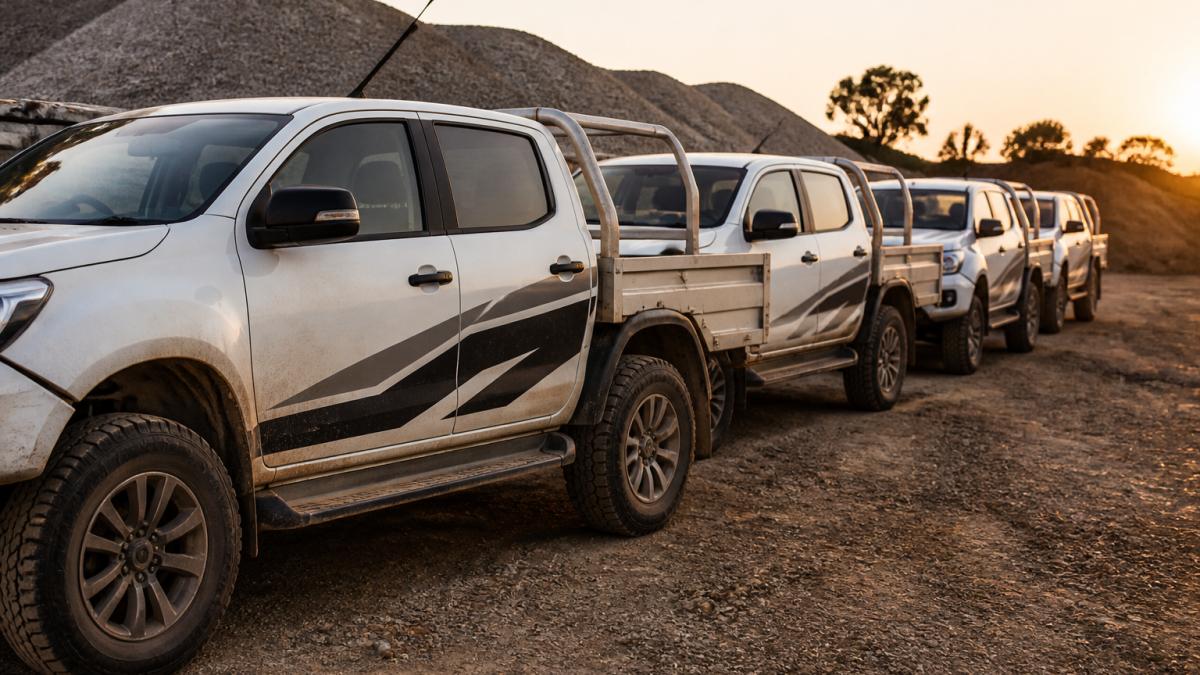
We recommend starting with the largest flat panel available, usually the front doors or the tub sides, and building outward. Our Custom 4WD Ute Stripe Kit is made to order for each model, including the Toyota Hilux, Ford Ranger and Nissan Patrol, and comes with transfer tape and instructions.
Logo Placement and Contact Details That Read at Distance
Logo placement should be readable at 10 metres, not just in a showroom. Put the primary logo on the front doors, then size the phone number so it can be read by someone approaching from behind.
A common mistake is shrinking the phone number to fit a design. Phone number sizing should be the second-largest element after the logo. QR codes belong low on the rear panel where a pedestrian can scan them, never on a moving surface.
Choosing 4WD Vehicle Decals That Survive Off-Road Use
Durability comes down to three things: vinyl grade, surface preparation and edge sealing. Get any of those wrong and a decal will lift within a season.
Premium outdoor vinyl is cast or calendered film rated for long-term exterior exposure.
Surface prep matters just as much. Panels must be washed, degreased and dry before application. Dust under a decal becomes a bubble, and a bubble becomes a peel point.
- Wash and degrease the panel
- Check panel temperature is moderate, not hot from direct sun
- Apply with transfer tape and a squeegee
Fleet Vehicle Signage: Costs and Budgeting
Fleet vehicle signage costs vary with vehicle count, coverage, material grade and how much preparation each vehicle needs. Budgeting per vehicle is easier than budgeting per job, because it keeps a mixed fleet comparable and lets you forecast the cost of adding vehicles later.
Our own pricing gives you a realistic anchor for the smaller end of a 4WD branding job. A Custom Windscreen Sticker is $24.00 and measures roughly 700mm x 80mm. A Custom Windshield Banner is $75.00 at 1540mm x 280mm and is rated for 5-7 years outdoors. Heavy-duty Custom Truck Decals start at $25.00, and a full pinstripe set runs $140.00.


Those figures cover the product. A full fleet rollout also carries design, preparation, installation and downtime costs, and those are what actually move the total.
The Five Cost Drivers in a 4WD Branding Job
- Coverage level. A door logo and a windscreen sticker cost far less than side graphics, bonnet and rear panel work. Coverage is the single biggest lever on price per vehicle.
- Material grade. Outdoor-rated cast vinyl, reflective film and anti-graffiti laminate each cost more than standard calendered film. On a 4WD that spends its life in sun and dust, the cheaper film is often the more expensive choice over the vehicle's life.
- Vehicle complexity. Canopies, flares, snorkels, bull bars and curved panels add labour. A template that fits a flat ute tub will not fit a canopy without adjustment, and every model variation adds design and fitting time.
- Preparation. Panels must be washed, degreased and dry before application. Vehicles that have been on gravel or in mud need more prep, and prep is labour.
- Installation model. Supply-only kits with transfer tape cost less per vehicle but put the labour on your team. Professional fit-out costs more upfront but reduces rework and keeps consistency across a fleet.
Building a Per-Vehicle Budget
A practical way to budget is to price each vehicle by coverage tier, then add a contingency for preparation and model-specific adjustment. The table below shows how the tiers typically compare.
| Coverage Level | Typical Elements | Budget Consideration |
|---|---|---|
| Light | Door logos, windscreen sticker | Lowest cost per vehicle; suits pool vehicles and short-term leases |
| Medium | Door logos, side stripes, rear contact details | Balanced visibility and cost; the most common fleet choice |
| Full | Side graphics, bonnet, rear panel | Highest visibility, highest labour; best for customer-facing fleets |
Two budgeting habits make a real difference. First, budget per vehicle rather than per job, so a mixed fleet of utes, vans and trucks can be compared on the same basis.
Where Fleets Overspend
The most common overspend is rework. A design approved on a flat mock-up that wrinkles on a wheel arch means cutting and refitting, and that cost lands on top of the original quote.
A transparent quote should separate design, production, installation and any compliance elements, so you can see which line is driving the total and where a different coverage tier would save money.
Custom Truck Decals - Heavy Duty Tare Truck Stickers for a Bold Statement →
Mine-Site and Worksite Compliance in Practice
Worksite compliance is where generic branding advice falls short. Mine sites, civil projects and large construction jobs often impose their own vehicle signage, visibility and identification requirements on top of road rules, and those requirements vary from site to site and even between projects run by the same operator.
What most guides miss is that compliance is not a single standard you can design to once. A mine operator may require specific identification markings, reflective elements, height or clearance markings, or a particular colour code before a vehicle is allowed past the gate.
What Site Vehicle Standards Typically Cover
While the detail is site-specific, the categories are fairly consistent across resources and construction operations:
- Identification: company name, ABN or contractor number, and vehicle or fleet number displayed in specified positions and minimum sizes
- Visibility: reflective tape or chevron markings on the rear and sides, particularly for vehicles that work near mobile plant or at night
- Height and clearance: height markings or flags for vehicles with roof racks, canopies or light bars that change the vehicle's profile
A 4WD adds complexity here because accessories change the vehicle's dimensions and surfaces. A bull bar, snorkel, roof rack or canopy creates new panels to mark and new edges for vinyl to lift. Height markings must reflect the vehicle as configured, not as it left the factory, and reflective film behaves differently on textured plastic bumpers than on painted steel.
How to Plan Branding Alongside Site Requirements
Treat compliance as a design input, not an afterthought. The practical sequence is:
- Get the written spec first. Ask the site's induction or HSE team for their vehicle signage requirements before any artwork is approved. Verbal guidance changes with personnel; a written spec is what an auditor will check against.
- Map requirements to panels. Decide which markings go on which panels, and confirm those panels exist on every vehicle in the fleet. A canopy-mounted requirement cannot be met by a ute without a canopy.
- Separate compliance from branding. Keep required markings in fixed positions and sizes so they are never compromised by a design refresh. Branding can change; compliance markings should not.
- Check material compatibility. Reflective films, anti-graffiti laminates and standard cast vinyl have different adhesion and durability characteristics. Confirm the film suits the surface it is going on, especially on plastic and powder-coated accessories.
- Record everything per vehicle. Keep a compliance file with the artwork spec, material data sheet, installation date and photographs. That file is what you produce for an auditor, insurer or new site induction.
Keeping Compliance Current
Site standards change, and so do vehicles. A fleet that passed induction last year may not pass this year if the operator has updated its reflective marking requirements or introduced new height thresholds. Build a review into your fleet maintenance cycle: check the current site spec whenever a vehicle is added, rebranded or reconfigured with new accessories, and update the compliance file at the same time.
Rolling Out Branding Across a Mixed Fleet
Consistency across multiple vehicles is a planning problem, not a design problem. The fleet that looks sharpest is the one with a locked template set.
Build a master template that defines logo size, clear space, phone number size and colour values.
- Lock the template before vehicle one is produced
- Photograph each finished vehicle for the fleet record
- Note any model-specific adjustments in the template file
For fleets that include boats, trailers or horse floats alongside 4WDs, our Custom Pinstripe Stickers at $140.00 per set let you carry the same visual language across every asset.
Vehicle Decal Maintenance, Repair and Removal
Vehicle decal maintenance is simple if it is regular. Wash with mild detergent, avoid high-pressure jets close to edges, and inspect after any off-road trip.
Small lifts can usually be pressed back with a squeegee while the vinyl is warm.
Removal is a heat-and-peel job. Warm the vinyl, peel slowly at a shallow angle, and clean residual adhesive with a suitable remover.
Frequently Asked Questions
What is included in custom fleet branding for 4WDs?
A typical package covers design concepts built around your brand identity, door and panel logos, contact details, tray or tub signage, and optional stripe kits. Most jobs also include artwork proofs, production on outdoor-grade vinyl, and installation. For work vehicles, add safety identification and any site-specific signage your operators require. Ask for a proof before production so you can check logo placement, phone number sizing and how the design sits across curved panels and flares.
How much does it cost to brand a 4WD?
Cost depends on coverage, vehicle count and whether you choose cut vinyl or full wraps. As a guide from Mega Sticker Store's range, a custom windscreen sticker is $24, heavy-duty custom truck decals start at $25, a custom 4WD ute stripe kit is $145, and a custom pinstripe set is $140. A full fleet rollout multiplies those per-vehicle figures, so budget for design, production and installation separately and confirm pricing per unit before you commit.
How long do vehicle decals last on a 4WD?
Quality outdoor vinyl on a well-prepared panel typically lasts several years. Mega Sticker Store's windshield banners, for example, are rated for 5-7 years outdoors. Off-road use shortens that: gravel spray, sun exposure and frequent high-pressure washing all wear edges faster. Keeping decals out of direct blasting from tyres, sealing edges properly at installation and washing with pH-neutral products will get you closer to the top of that range.
Can fleet graphics be applied to a 4WD with textured panels?
Textured plastic panels, unpainted bumpers and heavily contoured flares are the hardest surfaces for any decal. Vinyl needs a smooth, clean, dust-free surface to bond properly. Options include placing graphics on painted body panels instead, using smaller decals that avoid deep contours, or accepting that some textured areas will need a different approach. Always tell your supplier which panels you plan to cover so they can advise on material and installation method before production.
How do you keep branding consistent across a mixed 4WD fleet?
Build one master template with fixed positions for the logo, phone number and any required signage, then produce size variants for each model rather than stretching one design. Record panel measurements for every vehicle type in the fleet, including utes, vans and wagons, and keep the artwork files on hand for replacements. A written brand guide covering colours, fonts and minimum logo sizes stops each new vehicle from drifting into its own look.
How should you clean and maintain branded 4WD graphics?
Wash with lukewarm water and a pH-neutral car shampoo, using a soft mitt rather than a brush. Avoid high-pressure jets held close to decal edges, and skip waxing directly over vinyl. Check edges and corners monthly for lifting, especially after off-road trips, and clean dust and mud off promptly so grit does not work under the film. Prompt repairs of small lifts extend the life of the whole set and protect the paint underneath.
Branding a 4WD fleet is a durability decision as much as a design one, and the vehicles that look best after three years are the ones planned properly at the start. Mega Sticker Store supplies Australian-made decals in premium outdoor vinyl, with custom sizes and colours to fit your exact vehicles and a made-to-order process for each model. Get started with Mega Sticker Store and shop Australian decals built to handle real off-road conditions.