


How to Make Custom Decals Last Longer Outdoors
Last Updated: November 5, 2026
Quick Summary
Most quality custom decals last three to five years outdoors before fading or peeling becomes obvious. Premium cast vinyl films, correctly applied to a clean surface, can hold up for seven years or more, while cheap calendared vinyl can start cracking within a single summer.
- Vinyl car decals usually last three to seven years, depending on film type and parking habits.
- UV exposure is the number one killer of outdoor decals, breaking down pigments and making vinyl brittle.
- Cast vinyl with a protective laminate is a strong choice for vehicles, boats and caravans.
- Wash decals with mild soap, a soft sponge and plenty of water, then dry with a microfibre cloth.
- Replace a decal when edges lift and won't sit flat, colour has faded noticeably, or the film has cracked.
Table of Contents
- How Long Do Custom Decals Last? The Short Answer
- How Long Do Vinyl Decals Last Outdoors?
- How Long Do Vinyl Car Decals Last?
- Factors That Affect How Long Custom Decals Last
- The Best Vinyl for Outdoor Decals
- How to Make Vinyl Decals Last Longer
- Spotting Failure and Deciding When to Replace a Decal
- Ordering Custom Decals Built for Australian Conditions
- Frequently Asked Questions
How Long Do Custom Decals Last? The Short Answer
Most quality custom decals last three to five years outdoors before fading or peeling becomes obvious. Premium cast vinyl films, correctly applied to a clean surface, can hold up for seven years or more. Cheap calendared vinyl can start cracking within a single summer.
That gap matters. Mega Sticker Store makes its decals from premium outdoor vinyl, so the material is not the weak link. Installation and care usually decide how long a decal really lasts.
Most guides quote one lifespan for every decal, but a glass-mounted sticker and a decal on a sun-baked caravan panel live very different lives.
How Long Do Vinyl Decals Last Outdoors?
Outdoor vinyl decals typically last three to five years on a vehicle or exposed surface. The upper end depends on film quality, sun exposure and how well the surface was cleaned before application.
Sunlight does most of the damage. UV breaks down pigments first, so fading often shows before the vinyl fails.
Where the decal sits changes the maths:
- Horizontal surfaces like bonnets and roofs take the most sun and fade first
- Vertical panels facing away from the sun last longest
- Coastal areas add salt and moisture to the mix
- Inland heat speeds up adhesive breakdown
How Long Do Vinyl Car Decals Last?
Vinyl car decals usually last three to seven years, with the wider range coming down to film type and parking habits. A garaged vehicle with quality cast vinyl sits at the top of that range. A work ute parked outside every day sits lower.
Driving habits matter more than people expect.
Glass is generally a friendly surface for car decals, as windscreen and window stickers avoid direct paint contact and are easy to keep clean.
If you are planning decals for a work vehicle or fleet, browse our custom windscreen and vehicle lettering options to see what suits your setup.
Factors That Affect How Long Custom Decals Last
Five things decide whether a decal lasts three years or seven: the film, the adhesive, the sun, the weather and the surface.
Vinyl quality is the foundation. Cast vinyl conforms to curves and resists shrinking.
Adhesive quality decides the bond. A weak or aged adhesive lifts at the corners first, then water gets underneath and the whole decal fails.
Sunlight, UV Exposure and Fading
UV exposure is the number one killer of outdoor decals. It breaks down pigments and makes vinyl brittle, so fading and cracking arrive together.
Parking in shade, using a car cover or choosing a laminated film all slow the process. A caravan sitting outside year-round will fade earlier than a garaged daily driver.
Weather, Moisture and Temperature Changes
Rain, humidity and constant temperature swings test the adhesive bond. Moisture creeping under a lifted edge is how most decals begin to fail.
Heat is the quieter problem. Hot panels soften the adhesive, and repeated expansion and contraction works edges loose.
Surface Type and Preparation
Surface preparation is the factor you control most. Glass, smooth painted panels and flat gelcoat hold decals well. Textured plastics, oxidised paint and dusty surfaces do not.
A surface that is not properly cleaned is the most common reason a good decal peels early. The full prep routine is below.
The Best Vinyl for Outdoor Decals
Cast vinyl with a protective laminate is widely regarded as a strong choice for outdoor decals on vehicles, boats and caravans. It conforms to curves, resists UV damage and holds colour longer than calendared films. Suitability depends on the surface and how long you need it to last.
Calendared versus cast vinyl
Calendared vinyl is pressed between rollers. It is cheaper, comes in more colours and suits flat panels and short-term use.
Cast vinyl is poured onto a liner rather than pressed. It has no built-in memory, so it stretches and conforms to curves, rivets and recesses without springing back. It costs more but holds its shape and bond far longer on vehicles, caravans and boats.
Printed versus cut or layered decals
Cut vinyl is a solid coloured film cut to shape. There is no ink to fade, so the colour holds until the film itself degrades.
Printed decals use ink on a vinyl base. The ink is the vulnerable part: UV breaks down pigments and cleaning chemicals attack unprotected print. A laminate or resin coating brings printed decals close to cut vinyl; without it, colour fades well before the film fails.
Laminate options
Laminates come in gloss and matte finishes and in different thicknesses. Gloss is easier to clean and resists staining; matte hides scuffs but can show polish residue. Thicker laminates add UV and abrasion protection but are stiffer, which matters on tight curves. For caravans and boats outside year-round, a quality laminate is the biggest upgrade after cast film.
Estimating lifespan for the product you have
Use these ranges as a starting point, then adjust for exposure:
| Construction | Typical outdoor lifespan | Best for | Main failure mode |
|---|---|---|---|
| Calendared vinyl, unlaminated | 2-3 years | Flat panels, short-term signage | Edge shrink and lift |
| Calendared vinyl, laminated | 3-4 years | Flat vehicle panels | Fading at edges |
| Cast vinyl, unlaminated | 5-7 years | Curved panels, vehicles | Fading before film failure |
| Cast vinyl, laminated | 7+ years | Caravans, boats, long-term fleets | Adhesive failure if prep is poor |
| Reflective film | 5-7 years | Safety and identification | Stiffness on tight curves |
| Layered cut vinyl | 4-6 years | Bold designs on flat or gently curved panels | Lift at layer overlaps |
These figures assume a clean, correctly prepared surface, a mild climate and reasonable care. A horizontal panel in full sun, coastal salt spray, or a pressure washer held too close will shorten life regardless of film quality.
For printed designs, a laminate or resin coating protects the ink from sun and cleaning chemicals. If you want printed graphics made for flat surfaces and vehicles, you can browse printed vinyl options built for outdoor exposure.
How to Make Vinyl Decals Last Longer
Longer decal life comes down to two habits: applying it properly and cleaning it gently. Most premature failures tend to trace back to one of those two.
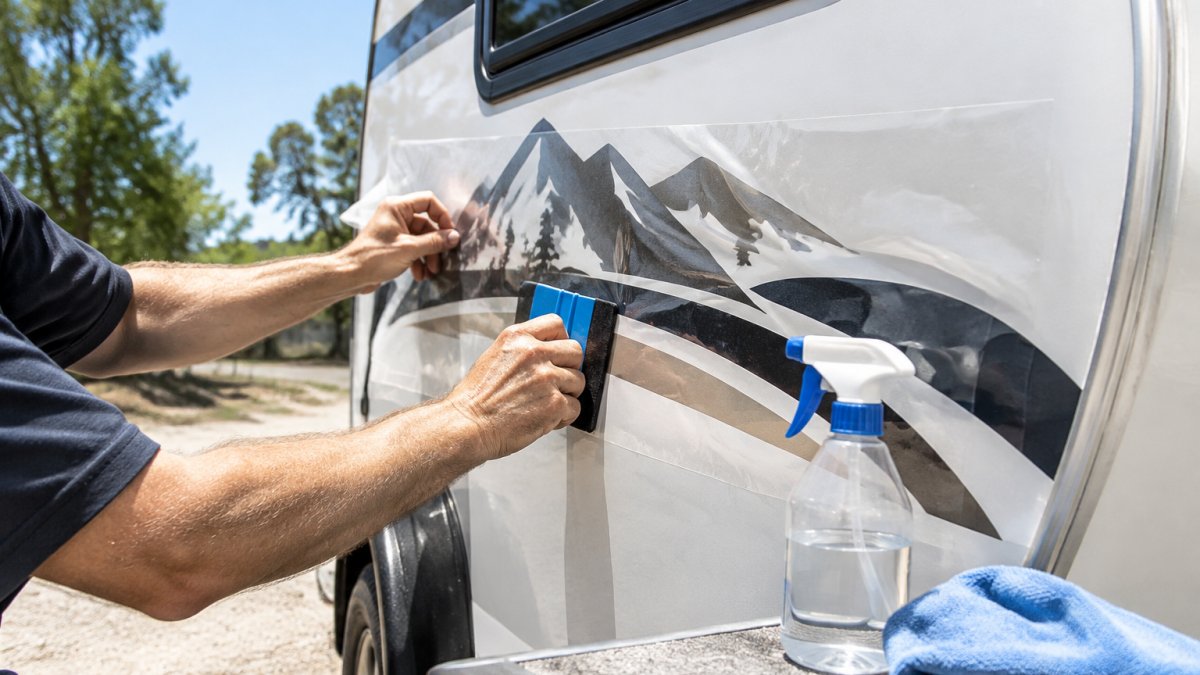
Installation and Surface-Preparation Checklist
Work through this list before any decal touches your vehicle:
- Wash the panel with mild soapy water and rinse well
- Wipe the surface with isopropyl alcohol to strip oils and wax
- Let the surface dry completely, with no residue left behind
- Check the panel temperature is mild, not hot from direct sun
- Position the decal dry or use a spray solution for slip
- Smooth from the centre out with a squeegee to push out air
- Work out any bubbles before the adhesive fully grabs
Rushing the squeegee stage traps air pockets that turn into lifting edges months later.
If you are about to install, a custom vinyl decal in a standard size is a good place to practise the checklist before tackling a full caravan wrap.

Cleaning and Maintenance Compatibility
Wash decals with mild soap, a soft sponge and plenty of water. Rinse thoroughly and dry with a microfibre cloth.
Skip these:
- High-pressure jets aimed close to decal edges
- Harsh solvents, bug removers or tar cleaners on the film
- Automatic brushes that catch lifted corners
- Polishing compounds over printed graphics
A pressure washer held too close will lift even a well-applied edge, and once water gets under the film, replacement is usually the only fix.
Spotting Failure and Deciding When to Replace a Decal
Consider replacing a decal when edges lift and won't sit flat, colour has faded noticeably, or the film has cracked or crazed. Small bubbles or a dull finish are cosmetic; lifted edges and cracking mean moisture is getting in.
Reading the failure mode
Fading is pigment breakdown from UV.
Cracking or crazing means the vinyl has dried out and lost its plasticisers.
Bubbles that grow rather than settle usually mean trapped moisture or a surface that was not clean at application.
Adhesive residue bleeding from under the edge is a sign the adhesive is breaking down.
Repair or replace?
A decal is a candidate for repair only if the film is intact, the lift is small and recent, and the surface underneath is dry.
Replace when the film is cracked, when lift keeps returning after resealing, when fading is significant, or when moisture has stained the surface underneath. On a vehicle, replace before a long trip rather than during one.
Removal and residue
Aged decals are harder to remove than fresh ones. The longer the adhesive has been on the surface, the more it grips and the more residue it leaves.
Residue comes off with an adhesive remover or isopropyl alcohol on a soft cloth.
Watch out: on older or oxidised paint, a decal can bring paint with it when removed, so test a corner before committing to a full peel.
Replacing without damage
Once the old decal is off and residue removed, treat the surface as a fresh install: wash, wipe with isopropyl alcohol, dry fully and check the temperature is mild. If the old decal left a faded paint shadow, the new decal may need to be slightly larger to cover it, or the panel polished to even the colour.
Ordering Custom Decals Built for Australian Conditions
Australian sun, heat and coastal salt are hard on vinyl.
Mega Sticker Store offers Australian-made decals from premium outdoor vinyl, with custom sizes and colours available. Its range is designed for caravans, motorhomes, 4WDs, boats and business vehicles.
If you are planning a long-term setup, explore vehicle stripe decals for caravans built to handle the road. For a broader look at local designs, shop Australian vinyl stickers suited to these conditions.

Decide what your vehicle needs, check the surface is ready, and order with time to spare before your next trip.
Frequently Asked Questions
How long do custom vinyl decals last outdoors?
Most quality outdoor vinyl decals last three to five years in full sun, and up to seven years on surfaces that get partial shade. Lifespan depends on the vinyl grade, whether it has a protective laminate, how much UV exposure it gets, and how well the surface was prepared before application. Cheaper calendared vinyl often starts fading or peeling within one to two years, while cast vinyl with a laminate holds up far longer.
Do custom decals fade in the sun?
Yes, all vinyl fades eventually because UV exposure breaks down the pigments and adhesive over time. The rate depends on the vinyl quality and whether a protective laminate or resin coating is applied. Decals on south-facing panels or boat surfaces that catch reflected light fade fastest. Choosing cast vinyl with a UV-resistant laminate and parking under cover where possible will noticeably slow fading.
What makes outdoor decals peel or crack?
Peeling usually starts at edges where moisture gets under the adhesive, often caused by poor surface preparation, applying in cold conditions, or stretching the vinyl too far around curves. Cracking comes from prolonged UV exposure drying out the vinyl, or from using a cheaper calendared material that shrinks over time. Prepping the surface properly and using quality cast vinyl with a laminate prevents most of these failures.
Can you wash a vehicle after applying a decal?
Yes, but wait at least 24 to 48 hours after application so the adhesive fully bonds. Hand washing with mild soap and water is safest. Avoid high-pressure washers directed straight at decal edges, and skip waxes or polishes that contain solvents, which can degrade the vinyl. For caravans and 4WDs, a soft brush and gentle detergent keeps decals clean without lifting edges.
